
Regulatory Breakthrough in Classical Chinese Medicine Innovation
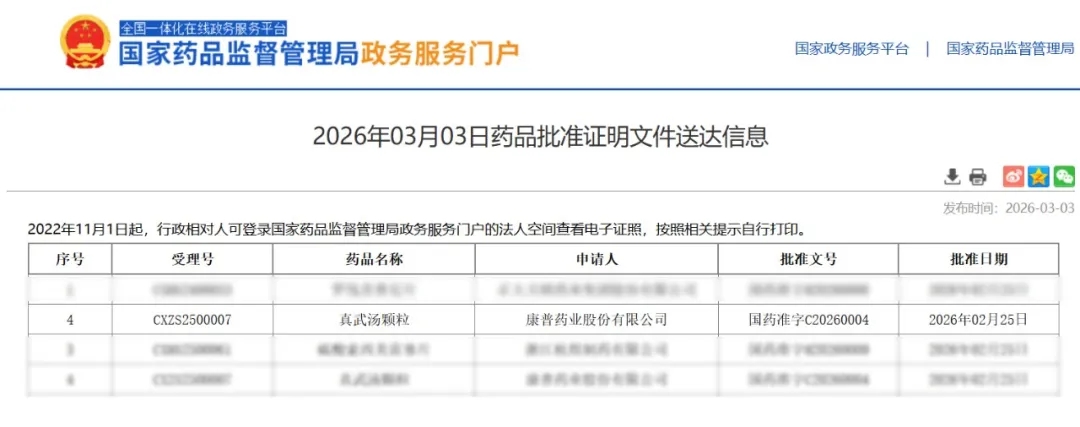
Recently, according to the National Medical Products Administration (NMPA), the traditional Chinese medicine (TCM) new drug Zhenwu Tang Granules, jointly supported by research from Hunan Yineng Biopharmaceuticals Co., Ltd. and submitted by Kangpu Pharmaceutical Co., Ltd., has officially passed technical review and obtained marketing approval.
This approval represents one of the first successful cases under China’s Class 3.1 classical formula drug pathway, marking an important milestone in the modernization and regulatory standardization of classical Chinese medicine.
It also demonstrates that ancient medical prescriptions are increasingly being integrated into modern pharmaceutical development systems with clear regulatory and industrial pathways.
What Defines a Class 3.1 Classical Formula Drug?
The Class 3.1 category refers to traditional Chinese medicine products developed from the National List of Ancient Classical Formulas (First Batch) issued by Chinese regulatory authorities.
Core Characteristics
Derived from validated ancient medical literature
Requires historical formula verification and documentation
Must undergo modern pharmaceutical development processes
Requires standardized manufacturing and quality control systems
Regulatory Value
This pathway represents a structured transformation model:
Traditional empirical medicine → standardized pharmaceutical product → evidence-based clinical application
It is currently one of the most clearly defined regulatory routes for TCM innovation in China.
Clinical Profile of Zhenwu Tang Granules
Zhenwu Tang originates from the classical medical text Treatise on Febrile Diseases (Shang Han Lun) and is widely used in conditions related to Yang deficiency and fluid metabolism imbalance.
Herbal Composition
Processed Aconite root
Atractylodes macrocephala
Poria
White peony root
Fresh ginger
Therapeutic Functions
Warming Yang and supporting metabolic balance
Promoting diuresis and fluid regulation
Addressing systemic fluid retention disorders
Clinical Application Areas
Cardiology
Nephrology
Respiratory medicine
Endocrinology
Gastroenterology
Gynecology
Clinical Significance
The formula is associated with a broad spectrum of chronic conditions such as edema, fatigue, cold extremities, and systemic fluid imbalance, indicating strong long term clinical demand.
How Modern Pharmaceutical Technology Enables Classical Formula Innovation
In this project, Hunan Yineng Biopharmaceuticals Co., Ltd. plays a key role in bridging traditional medical knowledge with modern pharmaceutical engineering systems.
Herbal Source Standardization
Ensures consistent botanical origin and reduces variability across production batches.
CMC Process Optimization
Improves extraction efficiency and stabilizes active ingredient composition through controlled manufacturing processes.
End to End Quality Control System
Implements full lifecycle quality management from raw materials to finished dosage forms.
Granule Dosage Form Advancement
The granule formulation significantly improves patient adherence, dosage convenience, and clinical usability in outpatient treatment settings.
This transformation improves both scalability and real world clinical adoption.
Industry Impact and Market Significance
The approval of Zhenwu Tang Granules reflects broader structural changes in China’s traditional medicine industry.
Key Industry Developments
Classical formula approval pathways are becoming more predictable
Ancient prescriptions are being transformed into scalable drug products
Demand for TCM R and D and CMC service providers is increasing
Integration between traditional medicine and modern clinical systems is accelerating
This positions classical formula drugs as a rapidly expanding segment within China’s pharmaceutical innovation ecosystem.
Frequently Asked Questions FAQ
What is a Class 3.1 classical formula drug in China?
It refers to traditional Chinese medicine products developed from officially recognized ancient formulas that undergo modernization and regulatory approval under NMPA standards.
What is Zhenwu Tang Granules used for?
It is used for conditions related to Yang deficiency and fluid retention, including edema, fatigue, cold extremities, and related systemic dysfunctions.
Why is classical formula drug development important?
It enables the transformation of traditional medical knowledge into standardized, evidence based pharmaceutical products suitable for modern clinical use.
What are the main challenges in TCM new drug development?
Key challenges include raw material consistency, process standardization, quality control, and clinical validation.
How can companies participate in classical formula development?
Companies typically need capabilities in pharmaceutical R and D, CMC development, regulatory submission, and integrated quality systems.
Partnership and Contact
For collaboration in:
Classical formula drug development
TCM regulatory strategy support
Pharmaceutical CMC CDMO services
Process optimization and industrialization
Please contact:
Hunan Yineng Biopharmaceuticals Co., Ltd.
Website: https://www.medgencetec.com/
Email: ynswyy@163.com
We are committed to advancing the modernization and global development of traditional Chinese medicine through robust R and D and industrial capabilities.
Post time: May-19-2026