
The countdown has already started.
For many Chinese patent medicine companies, July 1, 2026 is no longer just another regulatory date. Inside the industry, it is increasingly being called a “survival checkpoint.” Products that have long relied on vague or incomplete safety labeling may soon lose their market eligibility altogether.
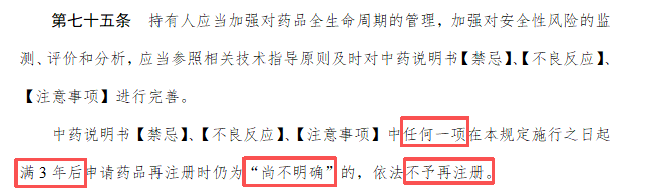
Under the Special Provisions on the Registration Administration of Traditional Chinese Medicines, issued by China’s National Medical Products Administration (NMPA) and officially implemented in July 2023, any Chinese patent medicine applying for re-registration after the three-year transition period cannot keep “Not Yet Clear” or “Unknown” in the sections for Contraindications, Adverse Reactions, or Precautions.
If even one of those sections remains unclear, the product may fail re-registration.
That changes everything.
China currently has around 57,000 valid approval numbers for Chinese patent medicines. A very large portion of them are now facing compliance pressure because of incomplete safety information.
More Than 70% of Chinese Patent Medicine Approvals May Be at Risk
For years, unclear safety statements have been common in TCM product inserts.
But what used to be treated as an industry habit is now becoming a regulatory liability.
A study published in the Journal of Traditional Chinese Medicine Management in November 2025 reviewed 1,424 Chinese patent medicine package inserts. The findings were striking.
51.6% listed adverse reactions as “unknown.”
47.2% listed contraindications as “unknown.”
41.0% listed precautions as “unknown.”
Even widely used hospital products were not exempt.
In one tertiary hospital survey involving 142 commonly prescribed Chinese patent medicines, nearly half still carried unclear wording in the “Adverse Reactions” and “Contraindications” sections.
The bigger concern is scale.
By the end of 2025, China still had roughly 57,000 active approval numbers for Chinese patent medicines. According to data cited by The Paper, more than 40,000 approvals still contained at least one “unknown” safety statement. That represents over 70% of the market.
Some are blockbuster products with annual sales exceeding RMB 100 million.
And regulators are no longer treating those vague descriptions as acceptable historical leftovers.
As toxicology research deepens and post-market pharmacovigilance systems improve, more traditional formulations are being associated with potential liver toxicity, kidney injury, allergic reactions, and herb-drug interaction risks.
In today’s regulatory environment, “unknown” is no longer a shield. It is a compliance gap that must be fixed.
Policy Direction Is Clear: Quality Now Matters More Than Quantity
This wave of label revision is not an isolated policy adjustment.
It reflects a broader transformation happening across China’s TCM industry.
Over the past several years, regulators have steadily tightened requirements.
In 2020, authorities first emphasized improving safety information in TCM instructions.
In 2022, technical guidelines for revising marketed TCM safety sections were released.
In 2023, the three-year compliance deadline was formally established.
In 2026, new filing guidance further clarified documentation standards for safety-related revisions.
The message has become increasingly direct.
Low-quality approvals will gradually exit the market. Evidence-based regulation is replacing the old extensive-growth model.
At the same time, broader industry policies are reinforcing the trend.
China’s 2025 policy document on promoting high-quality development of the TCM industry explicitly proposed improving the withdrawal mechanism for Chinese patent medicine approvals. Meanwhile, the Special Provisions on the Supervision and Administration of TCM Manufacturing, scheduled to take effect on March 1, 2026, strengthen quality oversight throughout the entire production chain.
The industry is shifting.
Not overnight. But unmistakably.
The era of “more approvals equals more competitiveness” is fading. What matters now is data quality, safety evidence, and regulatory credibility.
And for many companies, the package insert is becoming the first real test.
Only a Few Months Remain — And This Is Not Just “Editing Text”
Some companies still believe this issue can be solved with a simple wording adjustment.
It cannot.
A compliant safety revision usually involves multiple stages, technical reviews, and cross-functional coordination.
The workload is substantial.
Product Prioritization
Companies first need to sort products based on re-registration timelines, market value, clinical importance, and potential safety risks.
Core products should be prioritized immediately.
Waiting too long could compress the submission window beyond recovery.
Safety Data Collection
Enterprises are expected to strengthen pharmacovigilance systems and actively collect post-marketing adverse reaction reports.
For higher-risk products, regulators may also encourage supplementary clinical safety research.
This takes time. Sometimes months.
Evidence Conversion and Technical Writing
This stage is often underestimated.
Historical TCM literature, toxicology findings, published clinical data, and adverse event records must all be translated into standardized regulatory language that fits official package insert requirements.
That requires both technical expertise and regulatory experience.
Regulatory Submission and Review
Once revision materials are completed, companies must submit supplementary applications to regulatory authorities.
Review timelines alone may take two to three months, depending on the product category and submission quality.
Another important point often misunderstood:
Chinese patent medicines will not all disappear from shelves on July 1, 2026.
The key trigger is re-registration.
Since approvals generally follow a five-year validity cycle, products will be reviewed against the new standards when renewal applications are filed.
But for companies whose approvals are approaching expiration, the clock is already ticking.
Compliance Is No Longer Optional — It Is a Market Access Requirement
For pharmaceutical companies, the most dangerous response right now is hesitation.
The smarter approach is early action.
Many manufacturers are already launching dedicated label revision projects, building internal regulatory task forces, or working with external technical partners to accelerate compliance preparation.
A practical strategy usually includes conducting a full product inventory review, prioritizing high-revenue or high-risk products, establishing product-specific revision plans, integrating expertise from regulatory, clinical, and pharmaceutical teams, and strengthening communication with authorities during submission preparation.
Professional support can significantly shorten timelines and reduce avoidable filing risks.
More importantly, this transition is not purely defensive.
Better safety labeling can also strengthen clinical trust, reduce legal exposure, improve positioning during centralized procurement negotiations, and support future international registration efforts.
In other words, compliance is becoming part of brand competitiveness.
The Countdown Has Already Begun
For China’s Chinese patent medicine industry, this is not simply another paperwork exercise.
It is a structural reshaping of the market.
Products backed by stronger evidence, clearer safety data, and more transparent labeling will survive. Others may gradually lose their regulatory footing.
The signal from regulators is already very clear.
Companies that move early still have room to adapt.
Companies that continue waiting may soon find that the re-registration window has already closed.
Post time: May-12-2026