
TCM AI Large Models and AI-Driven Herbal Drug Development: A Paradigm Shift in Progress
What Is a TCM AI Large Model?
A TCM AI large model refers to a domain-specific intelligent system built on large language model (LLM) architectures, enhanced with deep integration of traditional Chinese medicine knowledge. It is trained on high-quality biomedical and TCM datasets, including:
* Chinese pharmacopoeia and drug standards
* Classical herbal formulas
* Clinical case records
* Pharmacological and biochemical research data
Such models are designed to go beyond simple knowledge retrieval. They can perform:
* TCM knowledge reasoning and understanding
* Herbal formula composition analysis
* Drug efficacy prediction
* Clinical pattern differentiation support
* Intelligent optimization of R&D workflows
In essence, a TCM AI large model is not just a knowledge system, but a **research-grade AI engine for scientific reasoning and drug development support**.
What Is AI-Driven TCM Drug Development?
AI-driven TCM drug development refers to the application of artificial intelligence across the entire herbal medicine R&D lifecycle, including:
* Screening and optimization of herbal formulas
* Prediction of pharmacological effects and targets
* Construction and validation of quality standards
* Process optimization in manufacturing
* Clinical data analysis and post-market evaluation
Compared with traditional approaches, AI transforms the paradigm from:
> Experience-driven development → Data- and model-driven development
The core shift includes:
* Trial-and-error → computational design
* Experience dependence → system-level reasoning
* Isolated optimization → end-to-end workflow integration
Policy Signal: Announcement of Hunan Province AI Large Model Recognition List
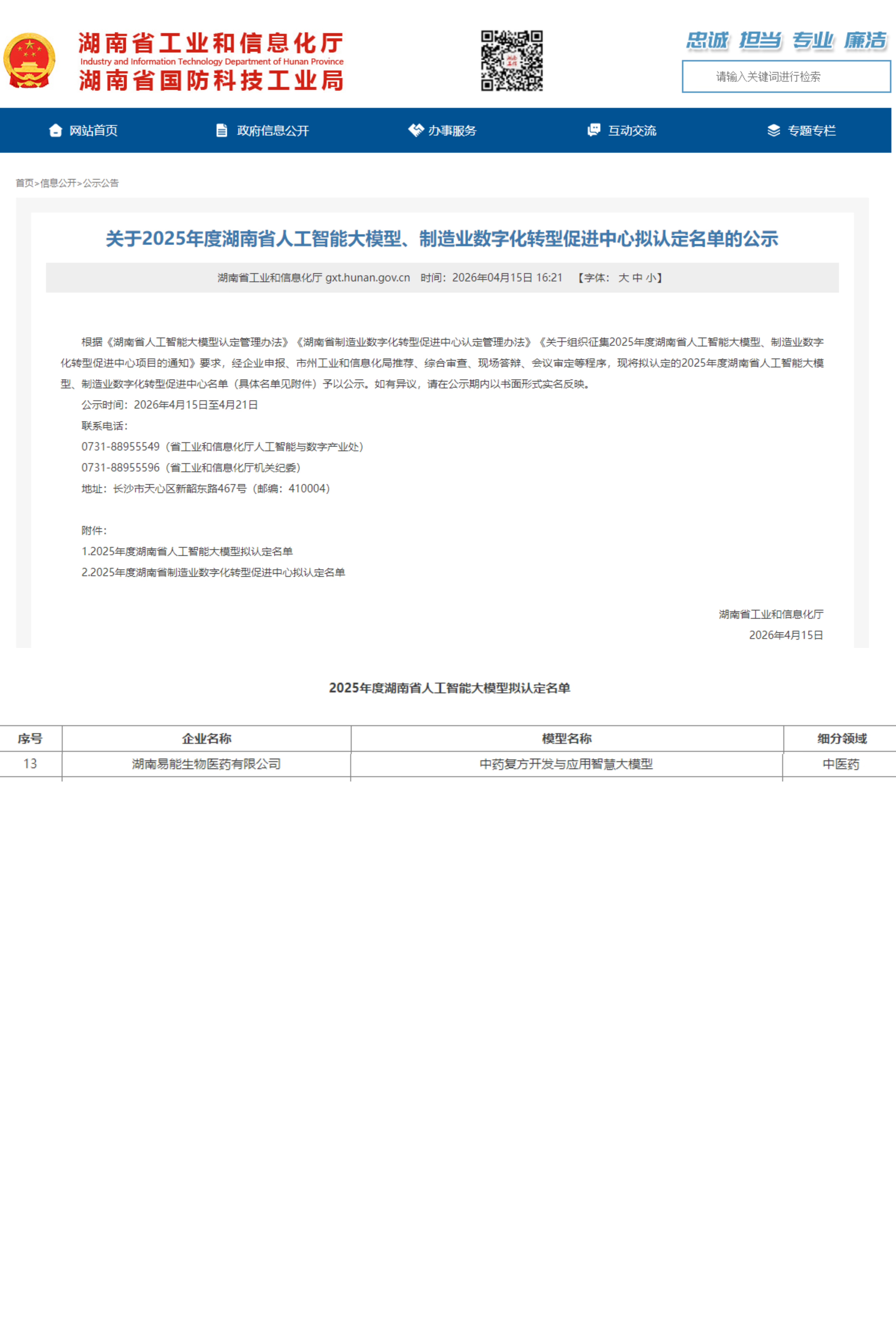
Recently, the Hunan Provincial Department of Industry and Information Technology released the “2025 Hunan Province AI Large Model Proposed Recognition List,” signaling accelerated regional efforts in:
* AI industrialization
* Industry-specific large model deployment
* Integration of AI with healthcare and pharmaceuticals
Among the selected projects, the **“Intelligent Large Model for TCM Formula Development and Application” developed by Hunan Yineng Biopharmaceutical Co., Ltd. (hereafter “Yinen Pharma”) was successfully included**.
This recognition indicates that:
> Yineng Pharma has achieved provincial-level validation of its AI + TCM integrated R&D capabilities.
Why Yineng Pharma Was Selected for the Provincial AI Large Model List
The selection reflects not a single technological achievement, but a comprehensive and systematic R&D capability. It can be understood across six dimensions:
1. Government Recognition: Official Provincial-Level Endorsement
Being included in the Hunan AI large model recognition list means the company has passed:
* Evaluation by provincial industry and information authorities
* Validation of real-world AI application capability
* Assessment of industry demonstration value
This recognition signals a key transition:
> From experimental AI development → to industrial-grade application readiness.
2. Technological Achievements: A Domain-Specific TCM AI Model
Yineng Pharma built its model on the **DeepSeek-R1 architecture**, with deep customization for TCM scenarios. Key innovations include:
* LoRA fine-tuning for domain-specific understanding
* Billion-parameter-scale training for advanced reasoning capability
* Retrieval-Augmented Generation (RAG) for external knowledge integration
* Deployment on domestic computing infrastructure for system autonomy
The model supports core R&D workflows:
* Intelligent herbal formula screening
* Drug efficacy prediction
* Process optimization
* Quality control system design
This represents an evolution from a single AI tool to a **full-cycle intelligent R&D platform**.
3. Industry Position: A Recognized TCM R&D Service Provider
Yineng Pharma has long been engaged in traditional Chinese medicine and natural product development, with strong industry positioning:
* Ranked among China’s Top 20 pharmaceutical CRO companies
* Certified high-tech enterprise in Hunan Province
* Provincial enterprise technology center
* Specialized provider of TCM innovation and R&D services
Its role extends beyond a service provider to:
> A foundational technology enabler in the TCM innovation ecosystem.
4. Drug Development Achievements: Scalable R&D Output
The company has demonstrated strong and continuous output in drug development:
* Multiple hospital formulations approved
* Contributed to 67 approved new drug filings
* Development of classical formula-based and modified TCM drugs
* Products such as “Linggui Zhugan Granules” and “Zhenwu Tang Granules” approved by the National Medical Products Administration (NMPA)
These achievements demonstrate:
> A fully operational R&D pipeline from technology to commercialized products.
5. Team Scale: A Multidisciplinary R&D System
Yineng Pharma has built a strong interdisciplinary team, including:
* Academician-led scientific advisory system
* Nearly 400 R&D professionals
* Expertise spanning pharmacology, AI, bioinformatics, and clinical medicine
* 20,000 m² digitalized laboratory infrastructure
This structure enables a complete capability stack:
> AI algorithms + TCM research + experimental validation in one integrated system.
6. Financing and R&D Investment: Sustaining Long-Term Innovation
In recent years, the company has significantly increased investment in AI + TCM integration:
* Secured RMB 100+ million in financing
* Established an intelligent TCM R&D base
* Built a full-category digital R&D system covering innovative drugs, classical formulas, and hospital preparations
This is critical because AI large model development requires:
* High computing resources
* Long training cycles
* Extensive domain-specific data
Sustained funding directly determines:
> Model iteration speed and upper-bound innovation capacity.
Conclusion: AI Is Becoming the “Second Engine” of TCM Drug Development
The case of Yineng Pharma illustrates a clear industry transformation:
* AI is no longer just a tool but part of the R&D infrastructure
* TCM drug development is shifting from empirical systems to computational systems
* Large models are becoming foundational infrastructure for pharmaceutical innovation
The inclusion of Yinen Pharma in the Hunan provincial AI large model list represents:
> Formal recognition of the integration between traditional Chinese medicine R&D capabilities and AI large model technology.
Looking ahead, AI-driven transformation is expected to bring:
* Faster drug development cycles
* Higher success rates in innovation
* More standardized quality systems for herbal medicine
* Systematic knowledge accumulation and reuse
Ultimately, AI is not only improving efficiency—it is fundamentally reshaping the methodology of TCM drug development itself.
Post time: May-25-2026